
The Mechanics
How DSCR loans actually work
One formula, five steps, zero tax returns. Here's the machinery — with a worked example you can check our math on.
The whole formula
Monthly rent ÷ monthly payment = DSCR
Payment means the full stack: principal, interest, taxes, insurance, HOA (PITIA). At 1.0 the property carries itself. Above it, cushion. Below it, doors still exist — they just have different names.
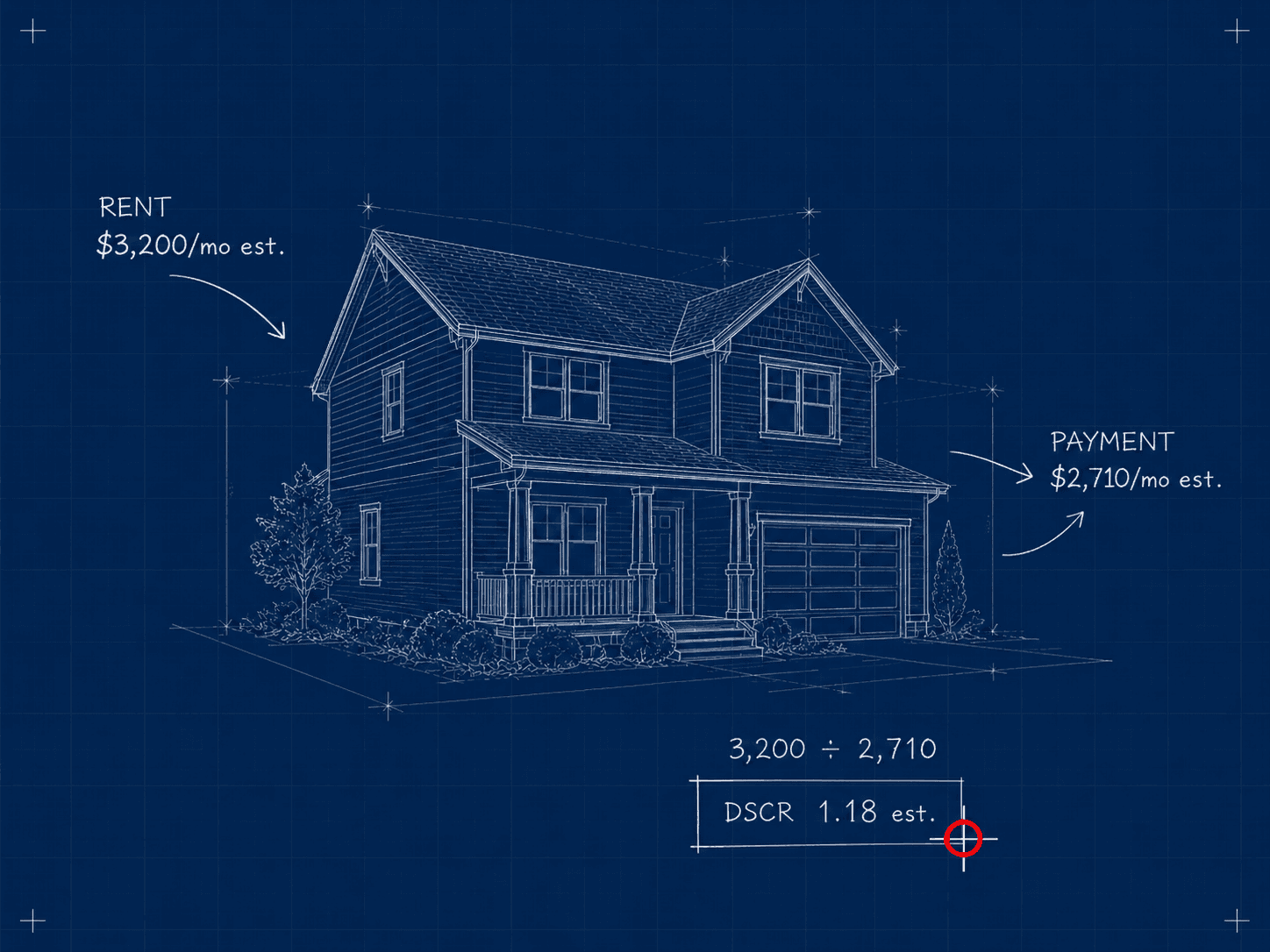
A worked example
| Purchase price | $400,000 |
| Down payment (25%) | $100,000 → $300,000 loan |
| Market rent (appraiser's 1007) | $3,200 / mo |
| Full payment (PITIA @ illustrative 7.25% planning rate) | $2,710 / mo |
| DSCR | 3,200 ÷ 2,710 = 1.18 |
A 1.18 means the rent covers the payment with an 18% cushion — solidly in qualifying territory for standard programs. Run your own property through the DSCR calculator or get the full analysis with real market-rent data.
The process, start to keys
- 1
Run the property's numbers
Address, estimated value, market rent, and your down payment produce the two numbers that matter: DSCR and LTV. Our free analysis does this — no documents.
- 2
Match to real programs
A specialist checks your ratio, credit band and property type against live program guidelines — including sub-1.0 and No-Ratio doors most borrowers never hear about.
- 3
Lock the structure
Rate, points, prepayment-penalty length, interest-only or amortizing — these trade against each other. This is where strategy earns its keep.
- 4
Appraisal + rent schedule
The appraiser values the property AND completes a market-rent analysis (the 1007). On DSCR loans that rent figure is load-bearing — it IS your qualifying income.
- 5
Close — often in an LLC
Entity vesting is routine. No tax returns, W-2s or employment verification were harmed in the making of this loan.
Why lenders are fine skipping your tax returns
It isn't generosity — it's a different risk question. A conventional loan asks "can this person's income absorb this payment?" A DSCR loan asks "does this asset produce enough to service its own debt?" Business-purpose investment lending gets to ask the second question, which is why the documentation list drops to credit, entity papers, insurance and an appraisal. The trade: rates price above conventional, prepayment penalties are typical, and the down payment does real work. Full detail on the requirements page.
What happens below 1.0
The 1.0 line is standard, not universal. Programs publish sub-1.0 tiers at 0.80 and 0.75 — usually wanting stronger credit or more down — and No-Ratio programsskip the DSCR test entirely for deals that stand on other strengths. A property that misses 1.0 at today's rent isn't a dead deal; it's a structuring conversation. See what counts as a good DSCR ratio for where the tiers sit. Which lenders publish those tiers, and on what terms, is where programs genuinely diverge — that comparison sits on choosing a DSCR lender.
See the formula run on your property.
Address in, analysis out: estimated value, market rent, your DSCR and LTV — then a specialist verifies every number against live guidelines.
How DSCR loans work — FAQ
How does a DSCR loan work?
A DSCR loan qualifies the property instead of your paycheck. The lender divides the property's monthly rent by the full monthly payment (principal, interest, taxes, insurance, and any HOA). If the result — the debt service coverage ratio — meets the program's minimum, typically 1.0, the property qualifies. Your tax returns, W-2s, and personal debt-to-income never enter the calculation.
How do I qualify for a DSCR loan?
Three numbers do most of the work: your credit score (program floors cluster at 620–640, with the most common qualifying tiers starting around 660–680), your down payment or equity (20–25% down is the standard purchase range), and the property's DSCR (1.0 is the standard minimum, with sub-1.0 and No-Ratio programs available). Add 3–12 months of payment reserves depending on loan size.
How do I apply for a DSCR loan?
Start with the property, not paperwork: an address plus estimated rent and value is enough to compute your ratio and see which programs fit. From there the formal file is thin by mortgage standards — credit pull, entity documents if closing in an LLC, insurance, and an appraisal with a market-rent schedule. No income documentation.
What monthly payment counts in the DSCR formula?
The full housing payment: principal and interest, property taxes, insurance, and HOA dues if any (PITIA). On interest-only programs, many lenders qualify using the interest-only payment — which raises your ratio and is one reason IO structures exist in this space.
How long does a DSCR loan take to close?
Because there's no income documentation to verify, the file mostly waits on the appraisal and title. With those moving, DSCR closings routinely run faster than comparable full-doc investment loans — the appraisal with its rent schedule is usually the critical path.
How many DSCR loans can you have?
There's no program-wide cap the way conventional loans limit you to ten financed properties. Each DSCR deal stands on its own property's numbers, which is exactly why portfolio investors use them — the fifth and fifteenth property qualify the same way the first did.
Ready to get started?
Request your free DSCR Analysis in about 30 seconds — or talk it through with a specialist first. No pressure, no obligation.